
Winnipeg
A Hopelessly Obdurate City

Winnipeg, Manitoba
I arrive from the west on the slick Trans-Canada Highway, freshly laden with snow, in my beaten up pickup truck. No one is driving particularly fast—whether due to the prudence demanded by icy Canadian highways or simply because no one has anywhere in particular to be, I am unsure.
The city skyline, visible for miles and miles, lurches towards me. Any other major city might confound the viewer, emerging as a behemoth from out of its smoggy miasma. But Winnipeg presents itself unceremoniously as a few unremarkable highrises amid boundless urban sprawl, like a copse of wheat stalks missed by the combine in harvest, left alone to wither on a flat and empty prairie. Any other city might conceal itself behind hills and mountains or hide in a river valley, emerging finally in a dramatic flourish. But Winnipeg lumbers lethargically forth over the flatlands to meet me.
For some strange reason, I always expect the city to have radically changed in my absence. But upon arrival, I find that the biggest news is that Portage and Main, the coldest intersection in Canada, is now open to pedestrians. As if they would want to cross there.
The same hobos inhabit the same bus shelters to stave off the selfsame arctic chill. The same Golden boy looks ever northward from his perch atop the Legislature, his vision of development and settlement still unfulfilled. The same Christmas lights adorn the boulevards on Main Street, like they always do, year after year. The same politicians with different faces pass the same political footballs back and forth—crime, health care, the fact that the province’s existence is essentially subsidized by Alberta1—without any sign of resolution. But also, the same familiar faces greet me upon my return, like the prodigal son, returned from the distant frontier.
Yes, this city is the same as I left it. It has not budged one inch.
Winnipeg is obdurate to the core. Early settlers remarked on the mire and muskeg which rendered farming an abortive task until a network of ditches was painstakingly dug to drain the swampy prairie. Before the streets of Winnipeg were paved, a viscous and sticky clay mud composed every thoroughfare, dogging down travellers on a good day, and on a bad day making the streets literally impassable. Though the Red River gumbo underneath the city has been paved over, it still sticks to the heart of Winnipeggers, creating a deeply held obstinance and resistance to change.
This city is stuck in the past, pathologically averse to progress.
For a brief period after its inception, Winnipeg experienced a flurry of land speculation and trading with the coming of the Canadian Pacific Railway. Plots traded hands so swiftly as to produce a superpositional zoetrope—at once, everyone owned land and no one did. Land prices rose beyond compare, with prime real estate beside the railway being among the most valuable on the entire continent.
As it was to be the “Gateway to the West” and the hub to all rail transportation between eastern and western Canada, Winnipeg was in a strategic economic position. The city’s boom seemed to have no end, and the sanguine predictions of disreputable land speculators held that the Winnipeg was bound to become the biggest city in Canada, if not the continent. This optimism was infectious, causing banks to establish magnificent neoclassical branches in downtown Winnipeg and the province to construct a grand edifice in the Beaux-Arts style for its legislature which almost bankrupted the provincial government.
But then, just as swiftly as the boom had arrived, the high spirits of Winnipeg were laid low by the construction of the Panama canal which rerouted continental traffic away from the Canadian Pacific Railway and instead to the shipping route opened up through Latin America. Winnipeg’s fortunes fled, its growth ground to a halt, and the result was a city frozen in time, like a sudden ice age that preserved a pristine woolly mammoth. The opening of the Panama Canal was a cataclysmic event which inflicted a deep trauma on the city, stunting its development thereafter in an entirely Freudian sense.
Winnipeg is stuck in the past. Not because there is some glorious past to return to, but simply because time ceased to progress in a meaningful sense after 1914. To even utter the word “progress” in this city is laughable.
And when I step out of my truck, I am met with the bittern northern wind which aids in explaining the city’s obduracy. For, that icy breeze which rips down through Manitoba from the Hudson’s Bay, and which intersects with the westerlies precisely in the downtown centre of Winnipeg, has no other effect but to stultify and paralyze whomever it should touch, turning breath to cloud and skin to ice. During the winter months, when snowfall renders our vehicles impotent and our flesh stiff, the only reasonable option is to hibernate.
So it is that I find myself holed up in Winnipeg, my erstwhile home—what has been called the loneliest city on the continent—for Christmas.
Years ago I left Winnipeg for Alberta—impelled perhaps equally by the opportunities in the oil patch as by my need to leave this city before it was too late. Winnipeg felt like a black hole drawing me further and further into its orbit, and if I spent even one more year here I may very well have crossed the event horizon, remaining forever—to invoke that cacophonous demonym—a Winnipegger.
Indeed, Winnipeg’s distance from anything noteworthy on the barren Canadian prairies only strengthens its gravitational pull. To escape from its orbit is a herculean feat only achieved by travelling great distances over the plains—and even so, it is far too easy to get bogged down en route and be forced to turn back. The city’s obduracy is infectious, whispering base bromides into your ear and convincing you to tough it out for a few more years, which turn into decades and then a lifetime. If I was to escape, I had to venture far afield.
And yet, it’s impossible to ever escape the gravity of Winnipeg for good. I still find myself returning here year after year, if only for a visit. I suppose it’s only natural for one’s home to have this effect on someone, no matter where in the world they find themselves. After all, I fear the man who can callously detach himself from any parochial affinity. And yet it feels as if Winnipeg has some exceptional draw.
It has historically been a meeting place for the native peoples who haunted this land before settlement, as Winnipeg occupies the intersection of the Red and Assiniboine Rivers, major thoroughfares before the advent of rail. And while, before the coming of rail, an insurmountable gulf separated western from eastern Canada, upon the completion of the CPR, Winnipeg acted as the intersection for the two, through which all transnational travel had to pass—a middle man between East and West, held tenuously together by a thread, defying Kipling’s dictum. Even still, the Trans-Canada Highway passes through the city, necessitating that any ground traveler catch a glimpse of Winnipeg’s dismal skyline.
It seems like, perhaps due to the internal logic of this place, because of its geographical position, or because of some chthonic forces lurking in its alleys and avenues, Winnipeg exerts a far greater gravity over men than most cities.
And on my third day back in the city, my Alberta license plate is stolen. Perhaps a bum walking through the back lane lifted it for a stolen car of his own. Or, perhaps it’s a friendly reminder from the city that I will always be a Winnipegger at heart. The former is far more likely, of course—but I suppose that both can be true at once.
What few charms the city offer upon my return soon wear off as the memories from years in these streets all came back. Being punched out while waiting for the bus. People shooting up crack in the open air near the university. Homeless tent cities adorning the river banks well into suburbia—all typical scenes from the murder capital of Canada. It does not take long to recall why I left.
Most people have answers as to why it is this way. In other decadent cities, people often scratch their heads and frantically investigate the causes of social malaise, but not Winnipeg. It’s not because people don’t understand the problems that they don’t get fixed—it’s through the city’s sheer unfailing obduracy.
Perhaps it is the lonely and dismal surroundings of this prairie city, the inescapable grey that pervades the streets, or the painfully slow pace of life here. No matter what reason, all can agree that there is something in this city which can madden any sane man, and all can agree that there is no point trying to fix it. You either put up with it and live here, or you move far away. There is, after all, little much else to do in this province.
It is a running joke of mine that there are three types of Manitobans: those who move to B.C., those who move to Ontario, and those who move to Alberta. And yet, upon closer inspection, this seems far too flattering an image—it supposes that the Manitoban is capable of moving at all. No, he is stubbornly stuck in place, trapped by the indomitable gumbo.
But then, I go for a walk over the Esplande Riel on a mild winter night, and I see the Forks alight with colours of every hue. I see skaters braving the cold to glide and stumble down the frozen Red River. I see the skyline lit up, those short and grey excuses for skyscrapers suddenly turned bold and bright beacons who banish the darkness. A bus passes and the faces inside look weary and yet unbroken by this city’s wanton ways.
In a moment, misanthropy turns to pure and unbridled goodwill towards mankind. In the sorry and downtrodden Winnipegger there suddenly appears a valiant spirit that staves off the cold and resists the harsh elements to carve out a life in this misbegotten place. Though they slog to their destination unceremoniously, though they complain the whole way, and though they face the indignities of urban life with only weak protest, there seems to be a molten core of ferocity beneath the sullen exterior.
And though I may be loath to say it, in that moment all the ugliness falls away like Autumn leaves, the contempt vanishes from my mind, the grey turns to a palette of neon, and—if only for an infinitesimally short moment—the utterly ravishing beauty of Winnipeg shines forth and staggers my soul. In an instant, my love for this city overflows and I am brought to tears. This is my home and I love it dearly. It is good because it is mine.
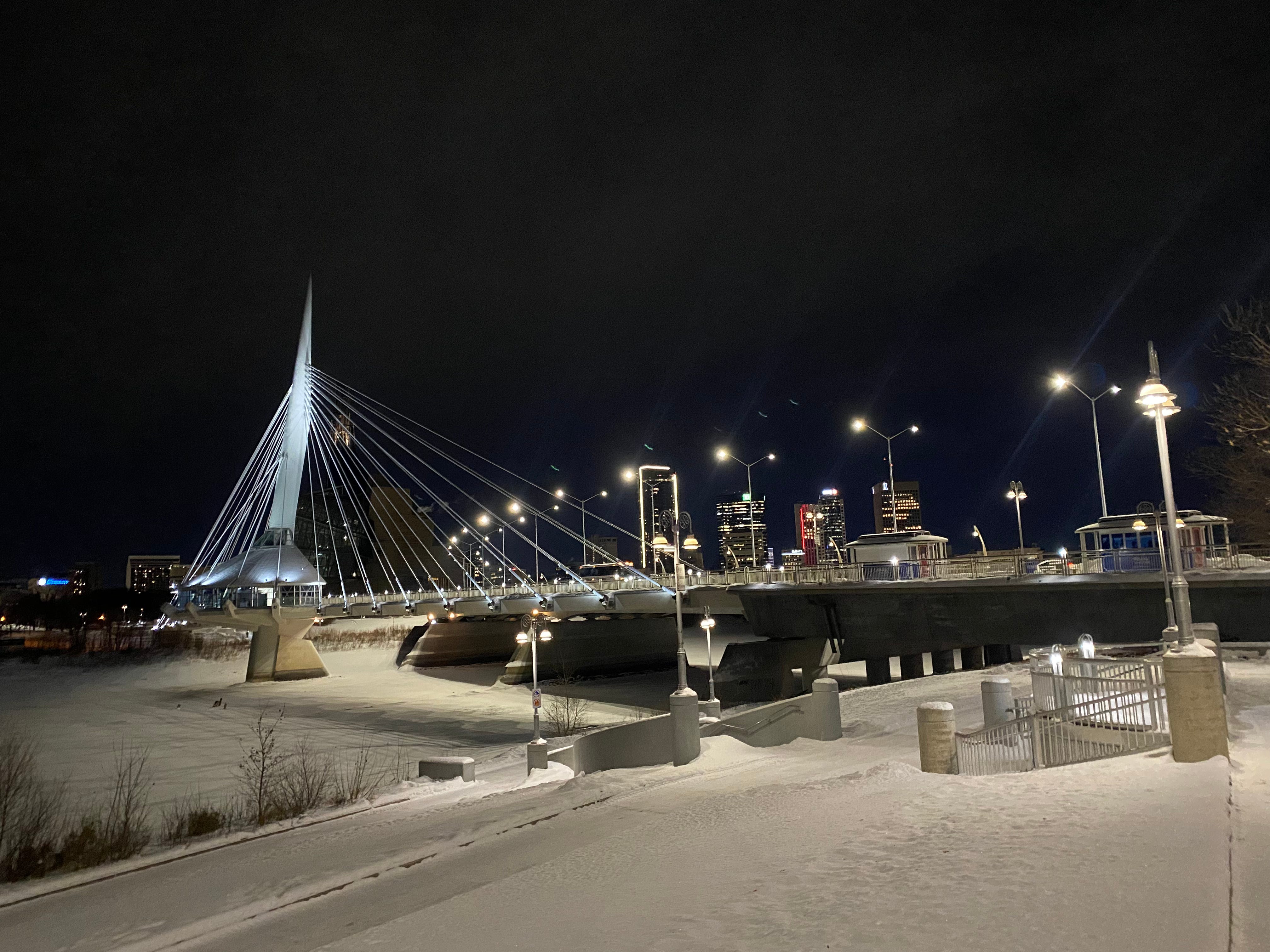
And then I notice a bum tweaking out under the bridge. Just like that, I am brought back to my senses.
This account may seem derisive and spiteful—and without doubt it is. But in equal proportion to my distain for this place, my heart brims with love for this sleepy and backward city—for its murderous and stubborn populace, its dysfunctional and dangerous public transportation, for the magnificent but dilapidated architecture from its glory days and grey brutalist cubes interspersed with striking irregularity. I may denigrate this place to my heart’s content, and yet the second an outsider says a bad word about Winnipeg, I rush to defend its honour.
No one is permitted to call Winnipeg a shithole except for those who earned their stripes in her frostbitten trenches.
Such reveals a paradoxical relation to place that most people doubtless experience. The place one grows up inevitably captures the heart of all but the most callous. It’s impossible not to develop affinity for one’s home, given that these formative experiences shape one’s taste—the very criteria according to which we judge the world around us. And yet, because we are so deeply integrated with such a place, we are also most acutely aware of its failings.
I’m inclined to believe that loyalty, and loyalty to place, is a virtue and an inextricable part of the good life. It may be ironic for me to say so, given that I have wilfully abandoned my home, but I do observe pieces of myself in this city. In all these familiar places, I see something of a mirror which reflects my own soul. And indeed, no matter where I am in the world, upon introspection, there is some part of Winnipeg attached to me.
This place is my home, and it is part of me. Accordingly, it is Good. To deny such an equation is to deny the self.
We are all likely to have this fraught relationship with a place, to view it as exceptional in some way or as uniquely formative. I am not special of unique in my simultaneous impulses to defend and denigrate this place. No, I imagine such to be the norm.
I can find any amount of good or ill in Winnipeg. But even still, a couple weeks is enough in this place. Once more, I long for the frontier. I can sense that the city feels the same about me—that I have overstayed my welcome. If I wait for something interesting or consequential to happen here, I will be left waiting until Gog and Magog collide in apocalyptic union. And so, as my temporary license plate is about to expire, I hit the road heading west, Alberta bound once more.
18% of the provincial budget comes from equalization payments, chiefly from Alberta.
They say man was made from clay and if we can't love the common clay we can't love anyone. (And if you can't love *this* clay, good luck with a universal).
If we're the apple of God's eye we're also the dirt in His eye, and He took it (I'm told on authority) "like a man." So that's all that. Couldn't hate dirt, sir, I couldn't hate it, though it was the serpent's punishment to eat it cause he's "too good for us."
I really appreciate your love letter to your home city. It's cold. NHL teams say the Fairmont is a shit hole. It isn't super face. But it's home isn't it? Why shouldn't you love where you came from and the people you shared it with and the Italian food? Been that way myself not a bad place I'm in BC and might want to go home to Edmonton that's like Winnipeg, Alberta version because it's what it is. North side for life buddy have a donair for me